A risk treatment is an action that is taken to manage a risk. Risk management processes all include steps to identify, assesses and then treat risks. In general, there are five types of risk treatment:
1. Avoidance
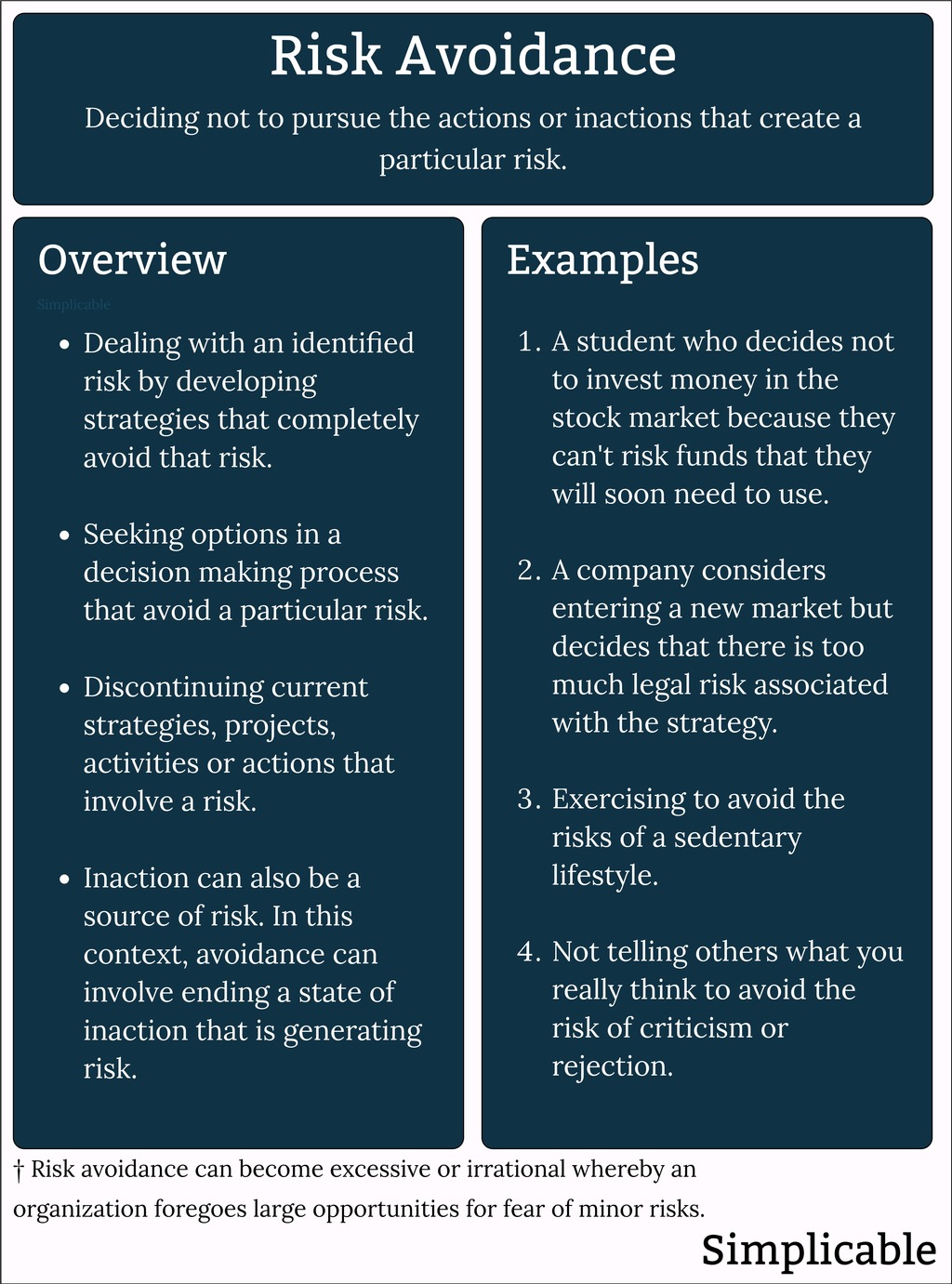
You can choose not to take on the risk by avoiding the actions that cause the risk. For example, if you feel that swimming is too dangerous you can avoid the risk by not swimming.
2. Reduction
You can take mitigation actions that reduce the risk. For example, wearing a life jacket when you swim.
3. Transfer
You can transfer all or part of the risk to a third party. The two main types of transfer are insurance and outsourcing. For example, a company may choose to transfer a collection of project risks by outsourcing the project.
4. Acceptance
Risk acceptance, also known as risk retention, is choosing to face a risk. In general, it is impossible to profit in business or enjoy an active life without choosing to take on risk. For example, an investor may accept the risk that a company will go bankrupt when they purchase its bonds.
5. Sharing
Risk sharing is the distribution of risk to multiple organizations or individuals. This is done for a variety of reasons including insurance products and self-insurance strategies.
Residual Risk
Risk treatments don't necessarily reduce risks to zero. Remaining risk after treatment is known as residual risk.
Secondary Risk
It's common for your efforts to reduce risk to have risks of their own. These are known as secondary risks. For example, if you outsource a project you will assume a number of secondary risks such as the risk that the outsourcing company will fail to deliver.
Summary
Risk treatment is any action that is taken to manage a risk. This includes risk acceptance whereby nothing is done to reduce the risk after a process of due diligence and sign off.
Cookies help us deliver our services. You have choices regarding these cookies. Please visit our privacy policy, cookie policy and consent tool to learn more.
Copyright 2002-2026 Simplicable. All rights reserved. This material may not be published, broadcast, rewritten, redistributed or translated. Report violations here.