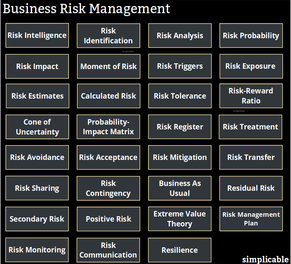
Risk identification is the process of listing out potential losses that are relevant to a business, team, project, process, activity, event, product or initiative. This is an intuitive and straightforward process that doesn't always need to be complex. The following are the basic techniques involved.
Stakeholder Participation
Communicate that you are working to identify risks and invite all stakeholders to contribute by a set date. This prevents the situation where stakeholders are asking you later why a risk wasn't identified. As risks are later evaluated and prioritized, any and all risks can be freely accepted and tracked.
Subject Matter Experts
Subject matter experts (SMEs) are people with knowledge in particular domains that are relevant to your work. It often requires specialized knowledge to identify risks such that involving SMEs is critical. For example, asking information security experts to identify cybersecurity risks.
Risk Workshops
Hold meetings for brainstorming risk. Invite all stakeholders and subject matter experts. Consider holding separate sessions for subject matter experts or different groups of stakeholders such as business units. These meetings give everyone an opportunity to contribute. Again, this helps to avoid the situation where a stakeholder is questioning why a risk wasn't identified.
Stakeholder Interviews
It is also possible to interview stakeholders in a structured way to try to identify risks. For example, asking about problems, challenges and failures of past projects and products.
SWOT Analysis
SWOT analysis is a popular business analysis technique that involves listing out your strengths, weaknesses, opportunities and threats. A risk is a combination of a weakness and a threat such that this can be used to identify risk. For example, if you have a weakness that your products are too slow and there is a threat that a competitor will release dramatically faster products, this may be a risk to your sales and business.
Reference Class Forecasting
Reference class forecasting is the process of using existing data for comparable things to create forecasts. For example, if you're constructing public infrastructure you could look at a database for past failures that occurred in similar projects. The term reference class forecasting suggests that you're looking at a big database such as an industry-wide dataset.
Past Risks
Looking at the risk registers or lists from similar initiatives within your organization. If you've had 40 historical projects on the same system, you should be able to compile a long list of risks from these projects to consider if they're applicable to your current efforts.
Checklists
As an organization or team, you can compile checklists or templates that are used to identify risks. For example, a checklist for system risks that includes a categories of common failures. These may also be available from standards or industry best practices.
Audits
Nonconformances identified by audits are essentially risks. For example, if an audit identifies a security control that is not in place, this is essentially a security risk and can be listed as such.
Basic Identification
Risks are initially identified at a high level as something negative that can happen. These are short statements that identify a negative outcome such as "restore from backup fails" or "data restoration failure."
Risk Probabilities
Beyond basic identification, it is helpful to capture a probability for each risk. Advanced risk management practices will use statistical analysis and risk models to estimate probabilities. For regular projects, it is common to simply categorize risk probabilities as low, medium or high.
Risk Impact
Identifying the loss or problem that a risk causes. In many cases risk impact is also estimated with broad categories such as low, medium and high.
Risk Exposure
Risk exposure is the likely cost of a risk and is calculated as probability × impact. This is intuitive. If you have a 20% chance of dropping an ice cream cone and that cone cost $5, your risk exposure is 20% of $5 or $1.
Risk Register
Capturing information and analysis such as probabilities and impact for each risk in a spreadsheet, database or tool. These repositories of risk are known as a risk register.
Secondary Risks
Risk identification is an ongoing thing and you can add to the risk register at any time. An important type of risk to capture on an ongoing basis is secondary risk -- the risk that you create by managing risk. For example, if a restaurant manages liability risk by removing a popular menu item that contains an allergen they may create revenue risks related to lost sales of the item.
Summary
Risk identification is the intuitive process of brainstorming and researching in order to identify potential problems and losses. This is one step in a broader risk management process.
Cookies help us deliver our services. You have choices regarding these cookies. Please visit our privacy policy, cookie policy and consent tool to learn more.
Copyright 2002-2026 Simplicable. All rights reserved. This material may not be published, broadcast, rewritten, redistributed or translated. Report violations here.