






Academic dishonesty | Accessibility barriers |
Behavioral challenges | Bullying and harassment |
Classroom discipline | Cost of education and college affordability |
Dropout rates | Education achievement gap |
Excessive student surveillance | Food insecurity, hunger and a lack of proper nutrition |
Funding cuts | Funding disparities and inequality |
Funding shortages | Gender discrimination |
High dropout rates | High-stakes testing |
Inadequate assessments | Inadequate facilities |
Inadequate feedback | Inadequate funding for special education programs |
Inadequate language support | Inadequate mental health support |
Inadequate processes for improving schools | Inadequate student housing |
Inadequate support for students from low-income families | Inadequate teacher training |
Inefficient school management | Insufficient education oversight |
Insufficient education standards | Insufficient or excessive testing |
Insufficient support for students with learning disabilities | Issues of free speech and censorship |
Lack of access to books | Lack of extracurricular programs |
Lack of field trips and hands-on learning experiences | Lack of gifted education and challenges for students |
Lack of lunchtime, recesses and breaks | Lack of outdoor education and nature experiences |
Lack of physical education | Lack of resources |
Lack of school transparency | Lack of student engagement |
Lack of support for immigration, refugees and undocumented students | Lack of teacher performance pay |
Lack of vocational education | Learning barriers in the classroom such as distractions and interruptions |
Low digital literacy | Low parental involvement |
Low student engagement | Low teacher evaluation standards |
Mismanagement of schools | Narrow or biased curriculum |
Outdated curriculum | Overcollection of student data and student privacy issues |
Overcrowded classrooms | Overfocus on rote learning |
Poor access for students with disabilities | Poor attendance and absenteeism |
Poor literacy skills | Racial discrimination |
School safety and security shortfalls | Standardized testing pressure |
Student debt | Student mental wellness |
Student motivation issues | Teacher bias |
Teacher burnout | Teacher pay issues |
Teacher retention issues | Teacher shortages |
Teacher training issues | Unequal or poor access to technology |
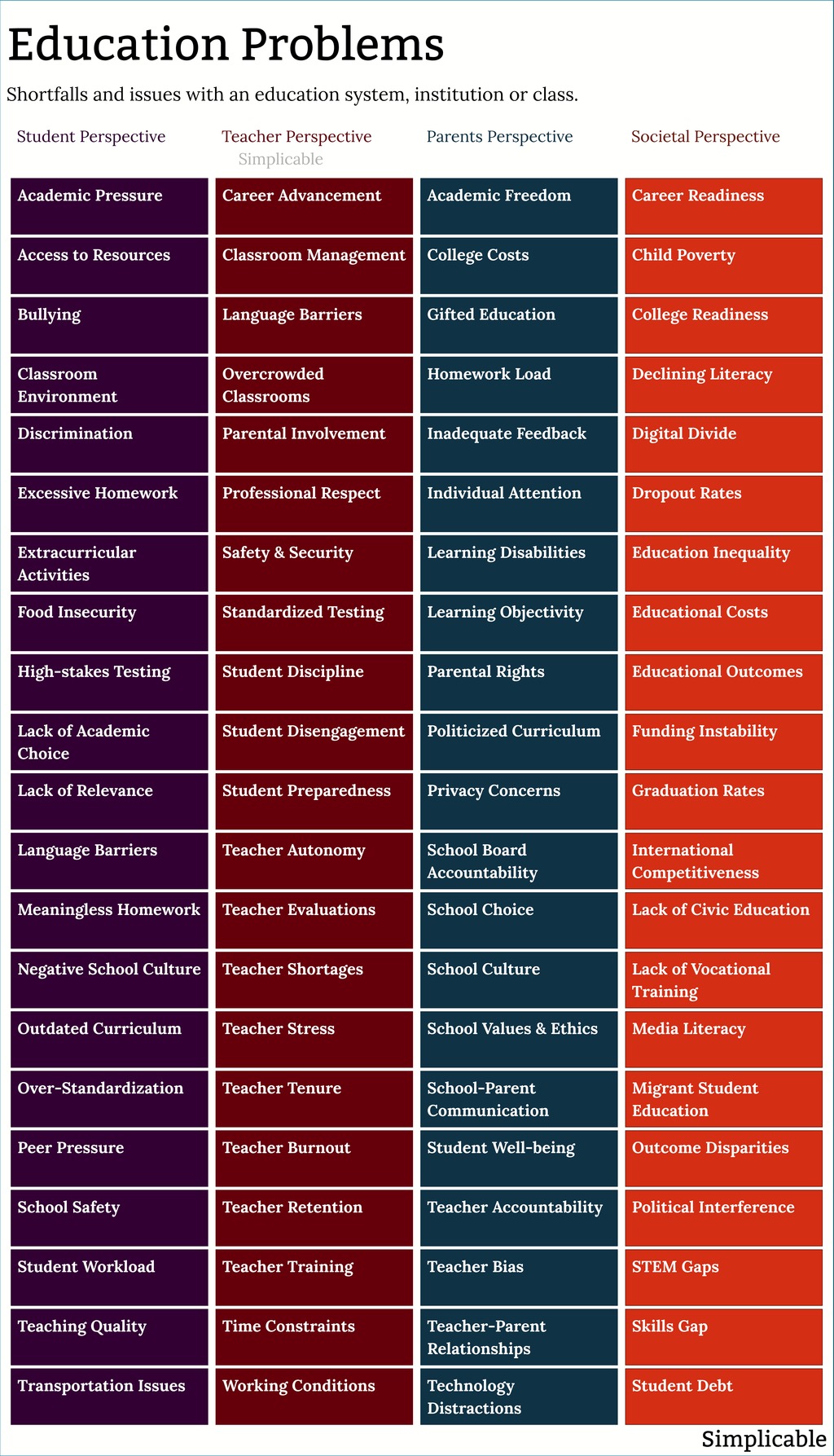
Student Perspective
Students may experience extraordinary stresses related to school including elements such as bullying, discrimination, social pressure and academic pressure. Students may additionally need help from their school to address adversity such as language barriers, food insecurity and transportation challenges. It is also common for students to feel that school isn't preparing them for the future with issues such as outdated or uninspiring curriculum.
Teacher Perspective
Teaching can be a difficult profession with challenging working conditions, a lack of resources, large class sizes, unprepared and disengaged students, student discipline issues and overinvolved or uninvolved parents. Teachers may additionally disagree with school system practices such as standardized curriculum and testing that remove teacher autonomy and the capacity of teachers to personalize instruction to student needs.
Parents Perspective
Parents generally seek to protect their children and give them every opportunity in life. Parent perspectives on education problems are diverse based on the needs of their children and parental beliefs about education. Educational issues can be divisive amongst parents. For example, some parents are enthusiastic about technology in the classroom while others are concerned about technology distractions and privacy issues.
Societal Perspective
Education is viewed as both a right and obligation that is a cornerstone of civility, social and economic thriving. Greater society is concerned with the fairness of education, its value to society and its costs. Additionally, schools are in a special position to mitigate serious problems such as child poverty and food insecurity.
Summary
Education problems are shortfalls, issues, challenges and risks related to an education system, institution, program or class. These can relate to the quality of education itself and social issues related to schools such as bullying or teacher working conditions.