Time is the progression of events from past to future. This appears to be a fundamental dimension of the universe. Like so many fundamental things, it is difficult to define. The following are key points that can be used to explain time.
Scientific Definition
Scientific definitions of time are distinctly unsatisfying as they are kinda obvious. In physics, time is "what a clock reads" (Considine, 1985). Definitions of time in science are typically similar to this, another example is "a quantity or a magnitude used to quantify the duration of events" (Study.com, 2025).
Arrow of Time
Time is the progression of events from past to future. It travels in one direction and can't be reversed. You can't travel backwards in time, as far as we know.
Cause and Effect
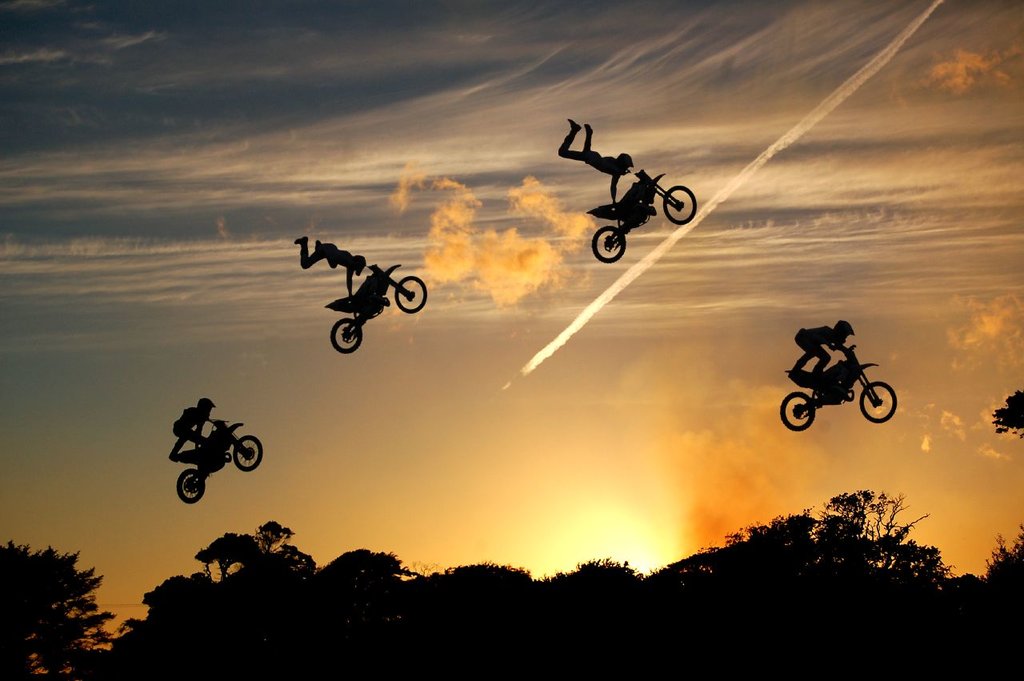
Time prevents everything from happening all at once. It is essentially a long series of cause and effect events whereby one thing causes another. Events can't be undone once they occur. For example, if you hit a jump on a motorcycle you have put in motion a series of cause and effect that can't be undone if you're unhappy with the results.
Time is Relative
According to standard physics, particularly Einstein's theory of special relativity, time is influenced by motion, speed and gravity. For example, time slows down for you if you travel very fast, particularly as you approach the speed of light. Time is also influenced by gravity such that it moves slightly slower on Earth than on a satellite orbiting Earth. For these reasons, it is kinda possible to travel forward in time in the sense you can slow time for you and return to a place where time was moving faster.
Past, Present and Future
Time has three distinct elements known as past, present and future. It is often argued that the present is the only thing that is real. This seems unlikely as the past feels real and the future keeps occurring such that it seems real too. However, it is certainly true that the present is the only time that you can directly influence. As much as we really may want ... we can't change the past. The future we can influence indirectly.
Time is Perceptual
From a scientific point of view, time is more or less constant for people on planet Earth. However, the experience of time is fully nonlinear whereby you may feel it rushing or dragging. For example, it tends to drag if you are waiting for something. It is also standard sociology that perception of time differs across cultures.
Time is Important
Time is a resource that can't be stored, bought, sold, paused, reversed, increased or decreased. That is to say that you have a fixed amount of time in a day, month and year. No matter what you may do this can't be changed. Likewise, human lifespans are currently limited. You might live to 100 or 110 but there is no way to extend this much further. From this perspective, time is important and is arguably the most important thing we have.
Time Creates Disorder
Entropy is a scientific concept from the Second Law of Thermodynamics that states that all things move towards greater disorder with time. This only applies to isolated systems that aren't influenced by an outside force. For example, if you leave your bicycle for 100 years, it will age. However, if you maintain it monthly you may prevent this by regularly replacing parts. Generally speaking, entropy means that time ages all things including the universe itself.
Time is Emotional
Time is a deeply emotional thing that greatly influences human behavior. We may long for the past with a sense of nostalgia. We may fear the future and the change that it will bring. Ultimately time represents our impermanence and the impermanence of all things. This can feel deeply mysterious or difficult to accept.
Summary
Time moves in one direction from past to future in a series of cause and effect events. It is a critical resource, a dimension of the universe and a deeply emotional part of the human experience.Next read: Importance of Time
Cookies help us deliver our services. You have choices regarding these cookies. Please visit our privacy policy, cookie policy and consent tool to learn more.
Copyright 2002-2026 Simplicable. All rights reserved. This material may not be published, broadcast, rewritten, redistributed or translated. Report violations here.