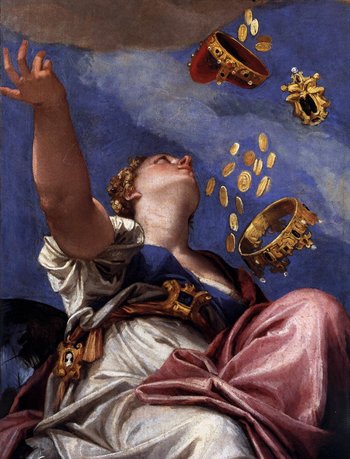
Money is a generally accepted medium of exchange that can be used to store and transfer value. This is one of the most important inventions in history that greatly improved the efficiency of economic transactions. The following are the key points to know about money:
Money is a Medium of Exchange
Money facilitates the buying and selling of goods and services. Without money you would need to trade with barter and this would be massively inefficient as this requires a double coincidence of wants whereby you need to find someone who has what you want and you have something they want.
Money is a Store of Value
As money can be used to purchase goods and services in future, it is a store of value. You can keep it and save it up to buy something later. This is also incredibly important and efficient as it allows people to save for emergencies and planned future needs such as retirement.
Money is a Standard of Deferred Payment
Money functions as a tool of deferred payment that allows individuals to loan money now and pay it back in future. This is also unbelievably important to the economy as it allows people to invest in businesses and buy expensive but important assets such as homes and cars.
Money Can Have Stable Value
The value of money can be reasonably stable over time. If the value of money becomes too unstable, payments become difficult and normal economic functions breakdown.
Money is a Unit of Account
Money provides a consistent measure for valuing goods and services, enabling comparison and calculation. This function standardizes prices and simplifies economic planning and record keeping. For example, businesses record their costs and revenues using money as a unit.
Money is Universally Accepted
Money is trusted and accepted as payment by businesses and people within an economy. It is also accepted as the unit of account by government and can be used to pay taxes.
Money is Fungible
Each unit of money is identical in value and interchangeable with another of the same denomination. This means it's not unique such as a diamond but it standardized such as a bar of gold.
Money is Divisible
Money can be broken down into smaller units and can facilitate both very small and very large transactions.
Money is Portable
Money can be easily carried or transferred from place to place. For example, bills that you can put in your pocket or bank balances that you can transfer electronically.
Money is Durable
Money retains its form and value over time and through repeated use. This durability ensures that money can circulate without degrading quickly.
Money is Secure
Money must be easily identifiable and distinguishable from counterfeits. There must be a way to validate it and secure it.
Money is Scarce
The supply of money is limited to preserve its value. It would have little or no value if it is created without limit.
Money is Legal Tender
Legal tender is money that must be accepted for payment of debts under the law. Governments enforce this to maintain a monetary system.
Money is Socially Constructed
Money was invented by society and its value is rooted in perceptions. Almost everything is a social construct such that this doesn't mean money doesn't have value or is illusionary. In fact, it is often backed by large institutions like governments.
Money Can be Backed by a Commodity
Money was historically backed by reserves of a physical commodity like gold held by a government. This was known as the gold standard. This was partially abandoned by the United States in 1933 and completely ended in 1971.
Money Can be Backed by a Government
The value of money can be backed by a government. Under this system, known a fiat, people can pay their taxes with the money and people are legally obligated to accept the currency for debts and payments. This effectively uses the power of the state to support the value of the money.
Money is Regulated by Institutions
Governments and central banks manage the creation, supply and flow of money. This is known as monetary policy and has a significant impact on inflation, employment and economic growth. As such, control over money gives the government and its institutions tools to manage the economy.
Money Enables Wealth Accumulation
Money allows people to accumulate and transfer wealth over time and across generations. It is the basis of savings, investment and capital formation.
Money Evolves with Technology
The nature of money changed beginning in the 1970s as it began to be represented as digital bank balances that can be transferred and used electronically without ever being used as cash. Today, digital currencies continue this evolution by enabling decentralized and direct electronic transactions outside traditional banking systems.
Summary
Money is a medium of exchange and store of value that is generally or universally accepted as a form of payment, to settle debts and to pay taxes. This is a social construct based on trust and perceptions. Even if money is backed by a hard asset such as gold, in the end this is based on the perception that gold has value.
2 Shares
Money
This is the complete list of articles we have written about money.
Cookies help us deliver our services. You have choices regarding these cookies. Please visit our privacy policy, cookie policy and consent tool to learn more.
Copyright 2002-2026 Simplicable. All rights reserved. This material may not be published, broadcast, rewritten, redistributed or translated. Report violations here.