
















Root cause analysis and fixing the root cause of problems | Process improvements |
Changes to procedures | Equipment maintenance |
Communication initiatives | Updating information |
Re-engineering processes | |
Designing out latent human error | Replacing equipment or infrastructure |
Replacing an underperforming partner | Workarounds |
Implementing automation such as a script | New or improved validations |
Policy updates | Risk mitigation |
Team culture initiatives | Training |
Audits | Data quality improvement |
New or improved integration | Quality control checks |
Error detection, reporting and notifications | Code changes |
Checklists and checkpoints | Redesigning products and services |
Improved materials, components or parts | Improved backup and restore processes |
Implementing standard operating procedures | New infrastructure |
New reporting | New or updated roles & responsibilities |
Updating performance objectives, measurements and incentives | Updated quality assurance or quality control practices |
Implementing or updating supplier scorecards | Increased resilience such as backup infrastructure |
Improved change control processes | Improved configuration management processes |
Improved record keeping and documentation processes | New workflows |
New approvals | Customer apologies, compensation and customer service recovery |
What Qualifies as a Corrective Action?
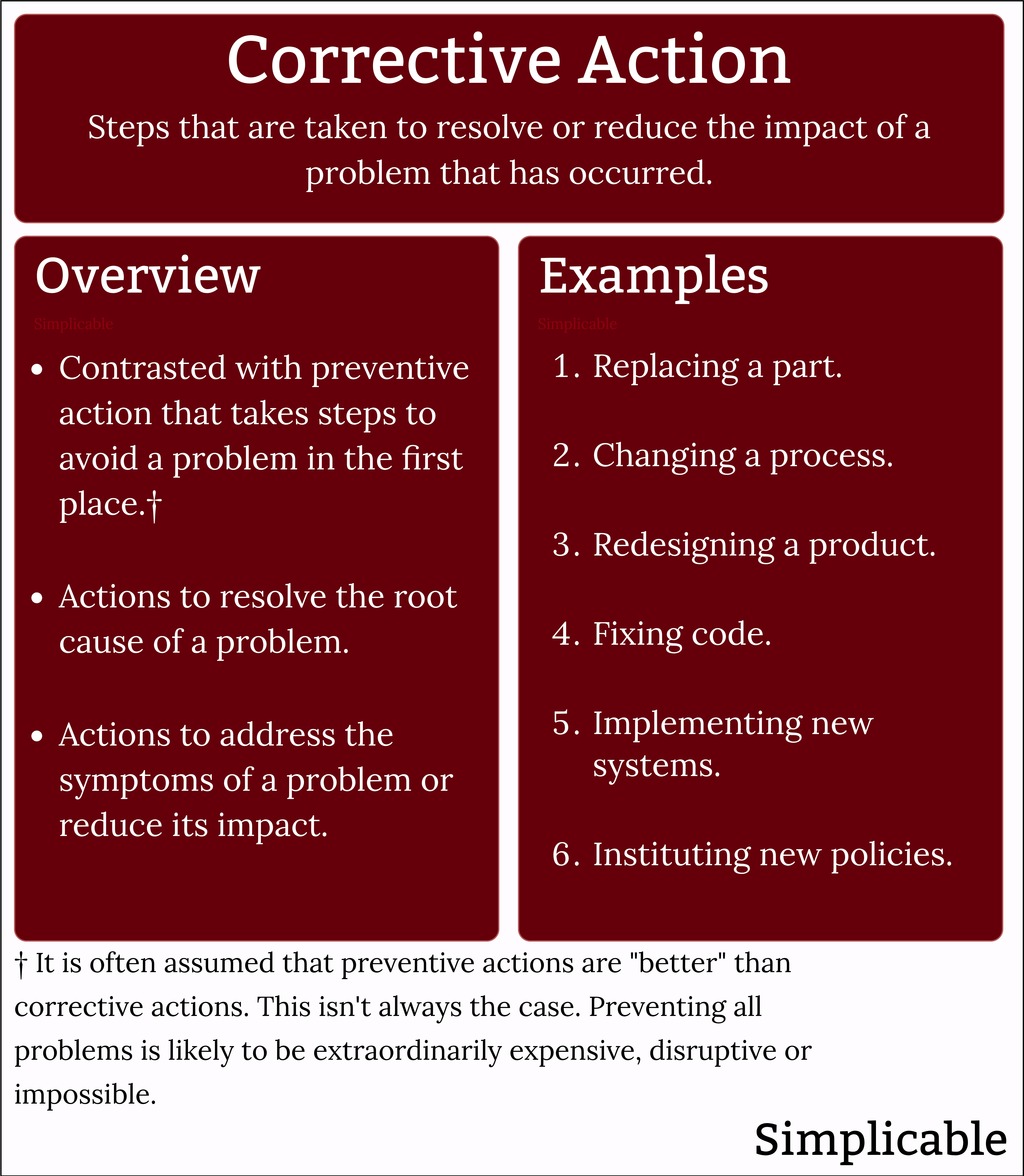
Any steps that are taken to resolve or mitigate a current problem are corrective actions. This includes steps taken to address the root cause of a problem or actions that reduce the symptoms of a problem. The following are additional examples:Projects
Addressing project problems such as a technical hurdle, business issue, schedule slippage or cost overrun. For example, a critical project resource suddenly resigns and it becomes clear they won't deliver a number of items. A corrective action is proposed that a more junior employee will attempt the work on a best effort basis. Alternatively, a consultant might be brought it to complete the work if stakeholders will accept the associated costs.Quality
Fixing products and services that don't conform to specifications. For example, replacing a machine on a production line that has a high error rate.Operations
Operational corrective actions such as maintenance on equipment and assets that are broken.Performance Management
In the context of performance management, corrective action implies a problem that can't be addressed with subtle feedback and coaching. It is often viewed as the last step before disciplinary action. For example, a corrective action might involve a formal verbal or written warning to stop being late for work.Information Systems
The incident management process of troubleshooting failures of IT services and infrastructure. A corrective action is often a short term fix such as backing out a recent configuration change.Compliance
A government regulator may issue corrective actions to firms that are in violation of laws and regulations. For example, a government might list corrective actions for a restaurant that is shut down due to insanitary conditions in the kitchen. Such actions might include a requirement to separate work areas, establish acceptable processes and perform cleaning tasks.Corrective Action vs Preventive Action
Corrective actions are taken after the problem occurs. Preventive actions are steps that are taken to try to avoid or reduce the impact of the problem before it occurs.Are Preventive Actions Better?
Preventive actions are often more effective and efficient than corrective actions. However, in the real world it is typically not possible, feasible or rational to try to prevent all problems as this would actually be remarkably expensive and likely impossible. As such, it is incorrect to think that preventive actions are better than corrective actions in every case or that they are inherently more efficient. For example, if you wanted to produce computers that malfunction only once every million years, this might be technically possible but would likely be extraordinarily expensive. In this case, making computers at a reasonable level of quality and quickly replacing them when they break down is likely the most efficient approach.Summary
A corrective action is a series of steps that is taken to resolve a problem or reduce its impact. This is one of two approaches to problem solving alongside preventative action that takes steps to avoid a problem before it occurs.