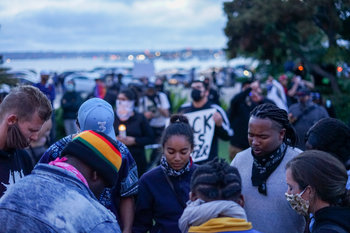
Anonymity is the state of being unidentified or unidentifiable within a given context. This was historically common as anywhere you went in public, there was no surveillance to identify you. In a modern setting with much technology available to automatically identify people, anonymity can be created with a specific law, policy, practice or norm. The following are the key things to know about anonymity:
Anonymity Prevents Identification
Anonymity is a situation where you essentially can't be identified. For example, an anonymous letter sent in the mail.
Anonymity Protects Privacy
Anonymity is one way to protect privacy. For example, if you are anonymous within a multiplayer game, people can't easily collect personally identifiable information about you within the game.
Anonymity Enables Agency
Anonymity allows you to take actions without fear of repercussions. For example, if you were anonymous in a chat you could ask a question without this ending up on your permanent record somewhere.
Anonymity Can Be Conditional
You could design systems where people are normally anonymous with limits such as if you break the law.
Anonymity Can Be Partial
Systems can provide partial anonymity such as identification with a pseudonym that can't be easily linked to your real name.
Anonymity Can Empower Expression
People may be free to speak and express themselves but if this becomes a digital footprint that is forever tied to them they may fear to speak candidly. Anonymity removes this problem.
Anonymity Creates Open Dialogue
Generally speaking, you will get more open, candid and unconstrained conversations where everyone is anonymous. For example, an employee survey that ties back to an employee id will receive very different responses from a survey that is guaranteed to be anonymous.
Anonymity Can Protect
Anonymity can increase safety and security by providing protection to the anonymous. For example, a government that protects the identity of a whistleblower who may otherwise face backlash from powerful institutions, government officials or corporations.
Anonymity Empowers Activism
Political dissent and social movements may face surveillance and reprisal without anonymity.
Anonymity Empowers Exploration
If you go to a nightclub that allows you to be anonymous your behavior may be exploratory and free as compared to the same club with heavy government surveillance that is creating records about you.
Anonymity Can Reduce Risk
Anonymity can reduce social, legal, economic and physical risks. For example, the risk of being stalked by someone you meet in a game.
Anonymity Reduces Self-Censorship
Anonymity allows you to say what you really think as opposed to worrying about fitting in with accepted narratives such as groupthink.
Anonymity Encourages Disclosure
People will generally share more information when they are anonymous. For example, a service that allows people to provide anonymous tips to the police.
Anonymity Removes Personal Accountability
People may break rules, violate norms and be generally less polite and considerate if they know they can't be held personally responsible due to anonymity.
Anonymity Can Generate Misinformation
Anonymity can make it easier for people and automation to push out misinformation.
Anonymity Can Create Risks
Anonymity can empower bad actors and create risk such as cybersecurity risks.
Summary
Anonymity is a situation where people and systems can't identify you. This can be partial or conditional whereby you can have something like a pseudonym that is normally anonymous unless there is a very good reason to disclose your real name to a proper authority. Anonymity creates freedom and agency whereby people can do things without this appearing on their permanent record. This was historically the norm such that anonymity can recreate historical conditions where actions didn't create a digital footprint.
3 Shares
Privacy
This is the complete list of articles we have written about privacy.
Cookies help us deliver our services. You have choices regarding these cookies. Please visit our privacy policy, cookie policy and consent tool to learn more.
Copyright 2002-2026 Simplicable. All rights reserved. This material may not be published, broadcast, rewritten, redistributed or translated. Report violations here.