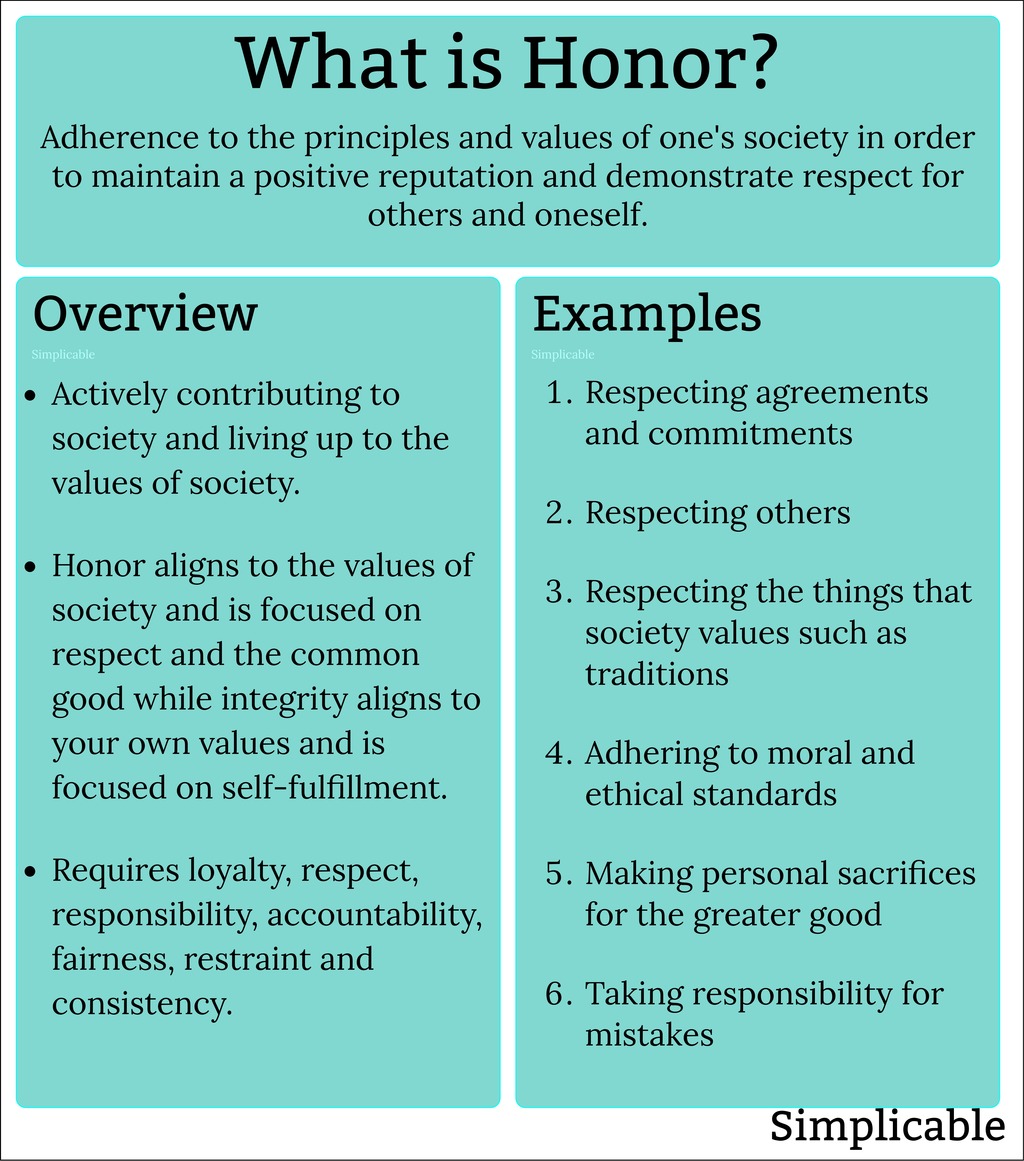
Honor is adherence to the principles and values of one's society in order to maintain a positive reputation and demonstrate respect for oneself and others. This relates to reputation and shared values unlike integrity that is more concerned with living up to your own principles as an individual. As such, integrity is more individualistic and honor is more collectivist. The following are the key things to know about honor:
Honor Aligns to Social Values
Honor is defined by how well one's actions and decisions reflect the ethical standards and values of the society or culture in which they live. This is about fitting into societal expectations and maintaining collective integrity which contributes to a person's reputation.
Honor Emphasizes Service
At its core, honor is about your service to society. Your contributions in both personal and social contexts is an essential measure of honor. This can be contrasted with integrity which is more about pursuit of your own vision and goals.
Honor Is About Respect
An honorable person treats others with respect and consideration by acting in ways that acknowledge the inherent worth and rights of others. Likewise, an honorable person demands and expects respect from others.
Honor Requires the Fulfillment of Obligations
An honorable individual is highly motivated to meet their commitments and responsibilities. This includes personal promises, social duties and professional obligations all of which are required to maintain an honorable status in society.
Honor Requires Ethical Decision-Making
A person with honor makes decisions based on what is fair and just by aligning to the values of their society and the institutions to which they belong.
Honor Demands Accountability
An honorable person takes responsibility for their behavior. They do not shift blame or avoid the consequences of their actions, understanding that their reputation is shaped by their capacity to be responsible.
Honor Demands Fairness
Honor requires an individual to act in accordance with the standards of fairness that are accepted by society. This involves treating others fairly, adhering to societal rules and ensuring that actions are reasonable within the context of the community's values.
Honor Reflects Loyalty
Honor involves loyalty to a group, cause or set of values that transcends personal desires. This loyalty is about protecting the collective good and upholding shared principles which strengthens your reputation within the group.
Honor Requires Restraint
In times of disagreement or tension, honor is demonstrated by maintaining composure and choosing responses that reflect dignity and respect. Resisting the urge to act out of anger or ego helps protect one’s reputation.
Honor Requires Consistency
As with integrity, honor aligns what you say with what you do. Likewise, the honorable must act in accordance with their values even if this is very difficult to do.
Honor Respects Tradition
Honor respects the things that are important to a community or culture such as tradition.
Honor Prioritizes The Greater Good
Acting honorably means prioritizing the well-being of the group over personal desires. Whether in family, work or community settings the pursuit of what benefits the collective is a key aspect of honor and maintaining a strong reputation.
Honor Defends Honor
The honorable will defend the honor of themselves and others. The defense of honor operates on multiple levels: protecting personal honor, defending the honor of others and standing up for the collective honor of a group or society. For example, saving face behavior whereby people try to avoid embarrassing others.
Honor is Not Drawn Into Dishonorable Responses
One of the core principles of honor is the ability to maintain composure and act with dignity, even when provoked. An honorable person refuses to be drawn into dishonorable responses, understanding that reacting with anger, deceit or dishonesty only tarnishes their reputation and undermines their values.
Summary
Honor is the ability to align your behavior to the ideals of a society or social group. This can be contrasted with integrity which is the ability to align your behavior to your own ideals. These may seem similar but are very different as honor is more concerned with aligning to society while integrity is the pursuit of your own values and principles. Generally speaking, honor is a collectivist behavior and integrity is an individualist behavior.
4 Shares
Character Traits
This is the complete list of articles we have written about character traits.
Cookies help us deliver our services. You have choices regarding these cookies. Please visit our privacy policy, cookie policy and consent tool to learn more.
Copyright 2002-2026 Simplicable. All rights reserved. This material may not be published, broadcast, rewritten, redistributed or translated. Report violations here.