














Adaptability | Affective Communication |
Agency Perception | Appeal to Authority |
Appeal to Emotion | Appeal to Fear |
Appeal to Logic | Applying Social Norms |
Assertiveness | Attribution - interpreting the causes of behaviors |
Avoiding Assumptions | Being Authentic |
Body Language | Building Rapport |
Building Trust | Charisma |
Code-Switching - adapting to social context | Collaboration |
Commitment | Conflict Avoidance |
Conformity | Consensus Building |
Consistency | Cooperation |
Coping With Emotion | Cross-Cultural Communication |
Cultural Adaptation | Cultural Awareness |
Cultural Capital | Cultural Collaboration |
Cultural Curiosity | Cultural Diplomacy |
Cultural Flexibility | Cultural Humility |
Cultural Integration | Cultural Knowledge |
Cultural Reflection | Cultural Resilience |
Cultural Sensitivity | Deception Detection |
Emotion Perception | Emotion Regulation |
Emotional Agility | Emotional Awareness |
Emotional Competence | Emotional Development |
Emotional Engagement | Emotional Literacy |
Emotional Maturity | Emotional Mirroring |
Emotional Performance | Emotional Resilience |
Emotional Stability | Emotional Understanding |
Empathic Accuracy | Empathy |
Establishing Credibility | Expressing Emotion |
Eye Contact | Facial Expressions |
Facilitation | Feedback |
Group Communication | Group Dynamics |
Humor & Wit | Immediacy - communicating a sense of closeness to others |
Impression Formation | Impression Management |
Inclusivity | Influencing Tactics |
Intention Attribution | Intercultural Communication |
Interpersonal Attunement | Interpersonal Perception |
Kairos - a sense of timing in communication | Language Comprehension |
Leadership Communication | Likeability |
Listening | Managing Objections |
Message Framing | Mindfulness |
Nonverbal Communication | Norm Conformity |
Nudges - using gentle suggestions to influence | Open-Mindedness |
Peer Pressure - managing it or resisting it | Personal Boundaries |
Personal Space | Perspective-Taking |
Persuasive Communication | Politeness & Etiquette |
Rapport | Reading Attitudes |
Reading Behaviors | Reading Between the Lines |
Reading Intentions | Reading Mannerisms |
Reading Moods | Reciprocity |
Recognizing Biases | Relationship Building |
Respectful Communication | Role Expectations |
Saving Face | Self-Awareness |
Self-Concept | Self-Control |
Self-Disclosure | Self-Efficacy |
Self-Esteem | Self-Presentation |
Self-Regulation | Self-Validation |
Silence as Communication | Small Talk |
Social Analysis | Social Attribution |
Social Categorization | Social Communication |
Social Comparison | Social Competition |
Social Confidence | Social Context - perceiving it and adapting to it |
Social Cues | Social Decision Making |
Social Dominance | Social Facilitation |
Social Heuristics | Social Identity |
Social Identity Development | Social Inference |
Social Influence Resistance | Social Influencing |
Social Judgment | Social Learning |
Social Prediction | Social Problem Solving |
Social Proof - using social popularity or acceptance to influence | Social Role Perception |
Social Status Perception | Social Strategy |
Social Support | Social Validation |
Surface Acting - being able to act out an expected reaction even if you don't feel it | Sustaining Relationships |
Sympathy | Theory of Mind - understanding that others have their own mind and can't read your thoughts |
Tolerance for Ambiguity | Trust Building |
Universal Politeness - elements of politeness that transcend cultural norms | Using Emotion |
Using Humor | Verbal Cues |
Social Perception
The ability to perceive people including their verbal communication, non-verbal communication, personality, intentions, attitudes and mood. Social perception also involves interpreting social context and group dynamics such as the relationships between people.
Social Cognition
Thinking that is relevant to navigating social situations and relationships. This includes the process of interpreting underlying thoughts, feelings, moods, attitudes and intentions. Social cognition also involves understanding group dynamics and developing strategies in real time to respond to social situations and communications.
Social Skills
Specific abilities that are used in social situations including elements of communication, influencing, resisting influence, social status, politeness, relationship building and maintenance.
Self-Monitoring
Monitoring your thoughts, behavior, emotions and progress in social situations. This includes perception of how others are perceiving you and your communications. For example, being able to tell if you are conforming to norms of politeness or if you are filling your expected role in a particular situation.
Emotional Intelligence
The capacity to read and understand emotions including your own and to engage with emotions or produce emotional outcomes. For example, recognizing how your emotions are influencing your thoughts and identifying a path to adapt your emotional state.
Social Influencing
The capacity to influence the ideas, emotions, behavior and direction of others including the direction of societies, institutions, organizations, teams and groups. Social influencing includes short term communication tactics known as persuasion and long term strategies such as demonstrating commitment and consistency to establish credibility.
Interpersonal Communication
Communication talents including different levels and types of communication such as formal communication that maintains a polite distance or friendly communication that expresses warmth and involvement.
Cultural Capital
The ability to socialize and influence within cultures that you have experienced. Cultural capital is based on shared meaning and experiences with others that may generally help you to socialize and build relationships. For example, if you have broad knowledge of a sport that may help you to get along with fans of that sport.
Cultural Intelligence
The ability to have positive social interactions and relationships with people from different cultural backgrounds. This has much to do with general approach and attitude such as trying to avoid assumptions and being humble and kind. Cultural intelligence also greatly benefits from knowledge of other cultures and awareness of how your culture might be perceived by others.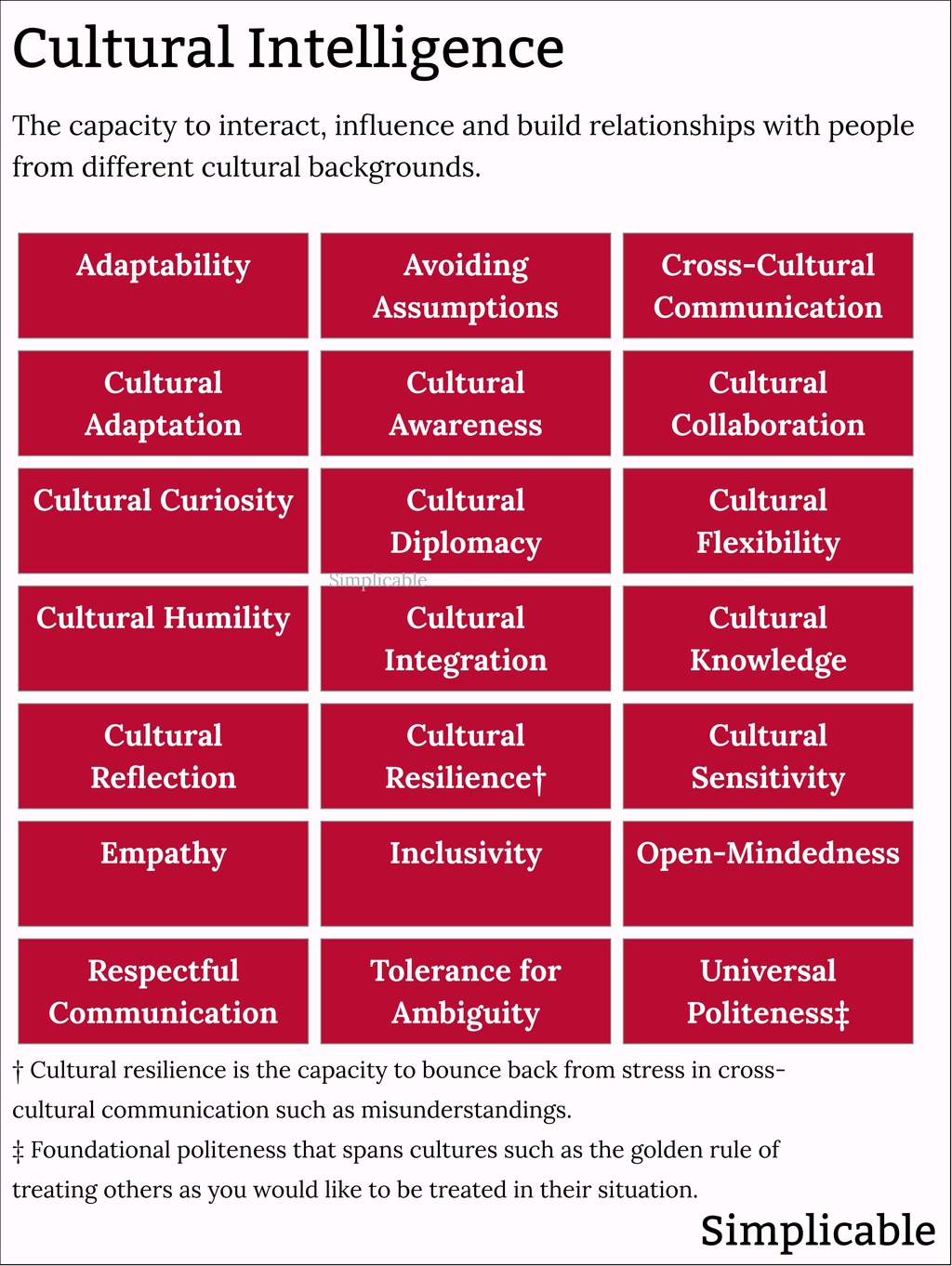
Summary
Social intelligence is the capacity to thrive and achieve goals in a variety of social contexts. This involves perceiving others including their state of mind, mood, emotions, intentions, character, social status and relationships to others. Social intelligence also involves understanding how others perceive you and how they are likely react to things you might say or do.