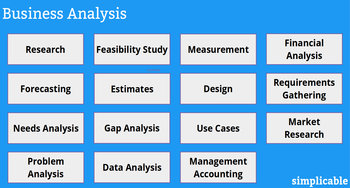
Business analysis is the practice of developing business strategies, plans, solutions and studies based on research. A business analyst doesn't typically own a strategy, plan or project but is tasked with capturing the needs of business and developing solutions and recommendations. The following are common types of business analysis.
Strategy Analysis
Analysis in support of strategic planning that maps out what an organization will try to achieve. This is often centered around business plans and business cases that propose a strategy and forecast its benefits, costs, risks and payback. Strategy analysis can also look at brands, products, innovation, organizational structure, strategic partnerships, marketing, sales and operations.
Market Analysis
Analysis of markets, customers and competitors including elements of marketing such as product positioning, pricing and distribution. Market analysis often focuses on customers and their needs, perceptions and feedback regarding current offerings. It can also look at the competitive landscape and market trends including technological, social, demographic and cultural change.
Analysis of business processes including elements such as workflows, tasks, standard operating procedures, systems, data and integration. This can include the design of new processes and the improvement of existing processes. Process analysis can involve gap analysis, benchmarking, experiments and studies designed to identify process optimizations.
Analysis that goes into project planning such as a business case, project management such as a work breakdown structure or project implementation such as system architecture. Project analysis may also be carried out separately by stakeholders and project governance teams.
Identifying risks, assessing them and developing plans to manage them. Risk analysis can also include risk monitoring, reporting and comparison of risk with rewards.
Analysis of the core value generating processes of an organization. This overlaps with process analysis but is more specific to different types of operations in areas such as manufacturing, facility management, logistics, information technology, order fulfillment and quality assurance. Operational analysis can include repeated analysis that occurs on a regular basis such as supplier performance reports that are issued quarterly.
A catch-all term for high level analysis of an organization by executives or administrative teams in areas such as human resources, risk management, quality assurance and compliance. Organizational analysis can look at structures, performance, processes, problems or culture. Outputs can be strategies, solutions, reports, communications, decisions, policies, plans or knowledge artifacts.
Cookies help us deliver our services. You have choices regarding these cookies. Please visit our privacy policy, cookie policy and consent tool to learn more.
Copyright 2002-2026 Simplicable. All rights reserved. This material may not be published, broadcast, rewritten, redistributed or translated. Report violations here.